
What makes a good prime rib isn’t just choosing the richest-looking roast. It’s how the cut, marbling, and cooking method work together. Marbling, the fine streaks of fat within the meat, contributes richness and flavor to each slice.
That’s only part of the picture. A well-chosen roast cooked gently and rested properly can be tender and satisfying while retaining its character. The sauce matters, too: au jus adds savory depth, gravy gives a fuller finish, and horseradish brings a bright, peppery contrast.
This guide covers how to compare cuts, assess marbling and beef grades, and use low-temperature roasting and resting to support tenderness. You’ll also learn how to choose sauces that complement prime rib without overwhelming it.
Key Takeaways
- Choose the first or second cut based on the balance of flavor and texture you prefer, and look for a roast with evenly sized ends for more consistent cooking.
- Use a low oven and let the roast rest in the turned-off oven to give it time to cook gently toward your preferred doneness.
- Look for fine, even marbling throughout the meat; a well-distributed fat cap can also help protect the roast and build flavor.
- Use the USDA grade as one guide to marbling, while weighing the roast’s appearance and the richness you want.
- Match the finish to the meal: au jus keeps the beef’s savory flavor in focus, gravy adds richness, and horseradish brings a sharp contrast.
Choosing between first-cut and second-cut roasts
Common mistakes include choosing a roast that won’t fit your pan or relying on cooking time alone instead of monitoring the meat’s progress. For food safety, keep raw beef and its juices separate from ready-to-eat foods. Clean your hands, utensils, and surfaces after handling the roast.
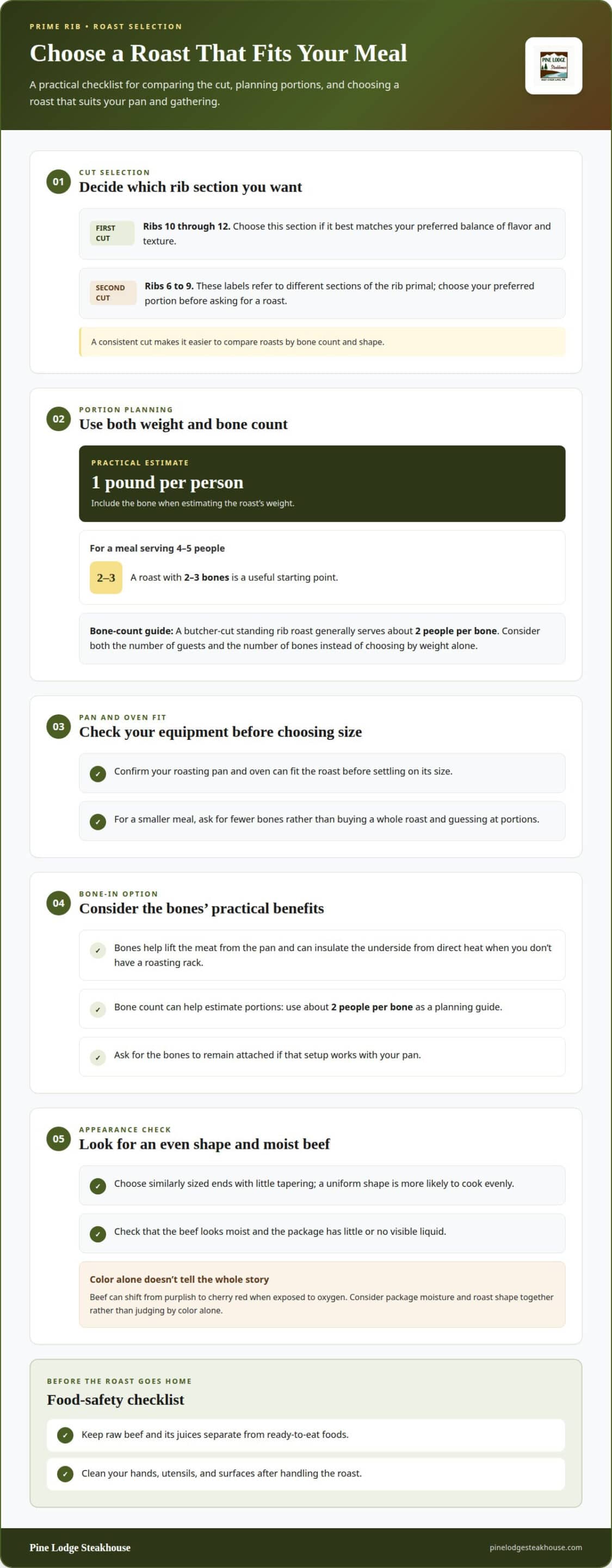
- Choose the cut that suits your preference. A first-cut roast comes from ribs 10 through 12, while a second-cut roast comes from ribs 6 to 9. These labels identify different sections of the rib primal, so decide which portion you want before asking for a roast. A consistent cut also makes it easier to compare options by bone count and shape.
- Plan portions before choosing the roast’s weight. A practical estimate is 1 pound per person, including the bone. For a meal serving 4-5 people, a 2-3 bone roast is a useful starting point. A butcher-cut standing rib roast generally serves about 2 people per bone, so use both the head count and bone count to avoid choosing by weight alone.
- Match the roast size to your equipment and gathering. Check that your roasting pan and oven can fit the roast before choosing its size. For a smaller meal, ask for fewer bones rather than buying a whole roast and guessing at portions.
- Consider a bone-in roast for structure and protection. The bones help lift the meat from the pan, and they can insulate the roast’s underside from direct heat when you don’t have a roasting rack. Bone-in roasts also make portions easy to estimate: use about 2 people per bone as a planning guide. Ask for the bones to remain attached if that setup suits your pan.
- Look for an even shape. Choose a roast with similarly sized ends and little tapering, as a uniform shape is more likely to cook evenly. Check that the beef looks moist and the package contains little or no visible liquid. Beef can shift from purplish to cherry red when exposed to oxygen, so color alone doesn’t tell the whole story. Consider the package’s moisture and the roast’s shape together.
Low-temperature roasting and oven resting
Use a controlled oven temperature, a thermometer, and a planned rest to guide the roast. The methods below distinguish low-temperature roasting from a separate weight-based timing formula.
-
Bring the Roast to Room Temperature
For Chef John’s method, set the roast out for 2 to 6 hours before cooking. This gives the meat time to lose some of its chill, helping it cook more evenly from edge to center. Keep the roast covered while it rests, and avoid leaving it out longer than this method’s stated window. Start the oven only when the roast is ready.
-
Calculate Cooking Time by Weight
For Chef John’s high-heat method, multiply the roast’s exact weight by 5 minutes to calculate its initial cooking time. A 4-pound roast, for example, cooks for 20 minutes before the oven is turned off. Don’t apply this formula to the separate low-temperature method below, which uses internal temperature and a longer cooking window instead.
-
Roast at a Low Temperature
For the low-temperature approach, set the oven to 200°F and roast for 3 to 4 hours, or until the center reaches 110°F. Use a meat thermometer rather than relying on the clock alone. For the final doneness targets given here, aim for 120°F for rare or about 125°F for medium-rare. First-cut and second-cut roasts can differ in shape, so temperature helps guide either cut.
-
Finish the Roast in a Closed Oven
Once the roast reaches 110°F, turn off the oven and leave the door closed. The method relies on retained heat to carry the roast toward its finishing temperature; opening the door releases that heat. In the separate 4-pound, high-heat recipe, the roast stays inside for 2 hours after the oven is switched off. Follow the timing for your chosen method.
- Salt and air-dry before roasting. Salt the roast, then refrigerate it uncovered for at least 24 hours or up to 4 days. This gives the surface time to dry before cooking. Keep this preparation distinct from the room-temperature step: refrigerate the salted roast first, then bring it out for the method’s specified room-temperature period before roasting.
A steakhouse method roasts prime rib at 180 degrees for most of a day. Another describes 18 hours in a 120-degree oven; holding it between 110 and 120 degrees helps enzymes break down connective tissue. Many dedicated restaurants, such as The Oxford Kitchen & Gastropub, embrace these kinds of patient, flavor-focused cooking techniques across their full-service dining menus.
Marbling and its effect on flavor and tenderness
Assess the fine fat within the muscle separately from the outer fat cap. Both contribute to the roast, but they affect flavor and cooking in different ways.
- Look for fine, even marbling. Examine the cut surface for thin white streaks distributed through the red meat. Evenly dispersed marbling generally indicates more consistent fat distribution than isolated patches. This pattern helps you assess the interior, not just the fat along the outside. Look for flecks spread across the eye of the meat rather than gathered in one corner.
- Consider how intramuscular fat shapes each bite. Marbling is fat within the muscle, not a thick strip along its edge. As the roast cooks, this internal fat contributes richness and helps the meat taste moist. It also adds flavor throughout each slice, making a well-marbled piece feel more succulent than lean meat with little internal fat. Compare the cut surfaces to judge the distribution.
- Assess the fat cap as a separate feature. A relatively thick, uniform cap can help protect the meat during roasting and add flavor and crispness. Look for an even layer rather than one that is thick at one end and thin at the other. The exterior fat cannot replace marbling within the muscle, so consider both features when evaluating the roast.
- Balance richness against the amount of visible fat. More marbling can bring fuller flavor, but the largest streak isn’t necessarily the best choice. Compare cut surfaces: fine, consistent flecks offer a different balance from large pockets concentrated between muscles. Choose the pattern that suits your preference for richness, while checking that meat remains visible throughout.
- Use marbling as one quality clue, not the only one. Consider the interior pattern alongside the roast’s shape, packaging, and fat cap. A well-marbled center with a relatively even cap offers internal richness and exterior protection during roasting. A lean-looking cut may still cook well, but it won’t have the same intramuscular fat distribution. Judge the whole roast rather than one striking feature.
Prime versus Choice beef grades
Use the USDA grade as one guide to quality. The label distinguishes Prime, Choice, and Select, but your preferred level of richness matters, too.
- Read the grade as a quality ranking. The USDA grades beef as Select, Choice, or Prime, from lowest to highest, with Choice in between. For a prime rib roast, the grade offers a straightforward way to compare packages. Treat it as a starting point, then consider how rich you want each slice to taste.
- Choose Prime for its higher intramuscular fat. USDA Prime-grade beef has 10 to 13 percent intramuscular fat. That fat is distributed within the muscle, contributing to a richer eating experience. If you prefer a fuller, more luxurious bite, Prime may suit your table. Still, the grade alone doesn’t tell you whether the roast’s fat is evenly distributed, so examine the cut itself as well.
- Consider Choice for a different balance. Choice sits between Select and Prime in the USDA’s three-grade ranking. It can suit diners seeking a quality roast without choosing the highest grade. Compare the visible fat within the meat and the roast’s overall appearance. The Choice label doesn’t mean every cut looks the same, so consider each roast’s individual features, too.
- Match the grade to the meal you’re planning. For a celebratory dinner where deep richness is central, Prime is the highest USDA grade and has its stated intramuscular-fat range. If you prefer a less rich profile, Choice may suit you better. Think about how you’ll serve the roast: sauces and side dishes can complement its flavor, while simple preparation keeps the beef in focus.
- Use the label alongside the cut, not instead of it. A USDA grade helps compare Prime and Choice, but it doesn’t replace checking the roast’s shape, fat distribution, and packaging. Compare packages with the same grade and choose the roast whose visible qualities suit your cooking plan. This makes the grade a practical guide, not the only measure of a good choice.
Serving prime rib with au jus, gravy, or horseradish sauce
Carve prime rib into ¾-inch slices and serve with a sauce that complements its rich flavor. Au jus, gravy, and horseradish each offer a different finish.
- Let the roast rest, then carve cleanly. Transfer the cooked prime rib to a cutting board and let it rest before slicing. For a bone-in roast, cut along the bones to separate them from the meat. Slice across the grain into ¾-inch pieces. This thickness makes each serving substantial while keeping the slices easy to plate.
- Offer au jus for a savory, lighter accompaniment. Au jus highlights the beef’s roasted flavor without coating each slice in thick sauce. Serve it warm in a small dish so diners can dip each bite or spoon a little over the meat. Keeping it separate preserves the browned surface and texture of each slice.
- Choose gravy for a fuller finish. Gravy is thicker and richer than au jus, making it a good choice when you want a more substantial sauce. Serve a modest amount beside the beef rather than covering the slice. The roast stays the focus, and diners can decide how much gravy to add.
- Add horseradish for a sharp contrast. Its lively, peppery flavor cuts through prime rib’s richness and brightens each bite. Offer it separately, especially when serving a group. Some diners may prefer a dab alongside the beef, while others may choose au jus or gravy. Separate sauces let everyone tailor the flavor without changing the roast.
- Arrange the plate so the beef stays central. Place each ¾-inch slice with its chosen accompaniment at the side, not beneath a pool of sauce. For a simple serving example, pair one slice with au jus and offer horseradish separately. If you’d rather enjoy a prepared steakhouse meal than carve at home, reserve a table for slow-roasted prime rib.
The recipe reports 1757 calories per serving, a figure to keep in mind when choosing a portion. Serve the slices and sauces in a way that lets diners decide what suits their plates, rather than adding more than they want. Keeping the accompaniments separate also makes it easy to enjoy the beef with au jus, gravy, horseradish, or no sauce.
Pine Lodge Steakhouse
At Pine Lodge Steakhouse in McHenry, near Deep Creek Lake, you can enjoy prime rib without preparing a roast at home. Slow Roasted Prime Rib brings a classic steakhouse centerpiece to the table, while Hand-Cut Steaks offer another beef option for diners comparing flavor and texture.
Use this guide to understand what makes a good prime rib, including how cut, marbling, grade, cooking, and sauces shape a prime rib meal. Then enjoy the flavors at Pine Lodge Steakhouse in McHenry, near Deep Creek Lake, with a sauce or accompaniment that suits your taste.
Contact Pine Lodge Steakhouse to plan your visit.
Make Your Next Prime Rib Meal Count
Understanding what makes a good prime rib can shape more than the roast itself. It can help you choose the meal you want to share, whether you’re preparing dinner at home or enjoying a steakhouse evening in McHenry, near Deep Creek Lake and Wisp Resort. Choose a classic cut for a gathering, a favorite sauce for a personal touch, or a meal without tending the oven.
Pine Lodge Steakhouse in McHenry, near Deep Creek Lake and Wisp Resort, serves Slow Roasted Prime Rib and Hand-Cut Steaks for guests seeking a traditional steakhouse meal. Creamy Crab Soup is another option to enjoy with dinner. Each brings a different flavor to the table, so choose what suits your appetite and company.
Make room for good food and an easygoing evening. Reserve your table at Pine Lodge Steakhouse, and look forward to a meal worth lingering over.
Frequently Asked Questions
What Is Marbling?
Marbling is the fine streaks of fat within a cut of beef, not the fat along its outer edge. In a rib roast, inspect the cut face for small, evenly spread flecks. A piece with fat distributed across its center offers a different balance from one with a large, isolated pocket. This visible pattern is one useful clue when deciding what makes a good prime rib.
What Is Prime Rib?
Prime rib is a roast cut from the rib section of beef, specifically ribs 6 through 12. It may be sold bone-in or boneless and roasted whole before carving into portions. The name refers to the cut, not automatically to the USDA Prime grade. For example, a rib roast can be labeled Choice, so distinguish the cut’s name from its grade when comparing options.
What cut of beef is best for prime rib?
Choose a standing rib roast from the rib section, ribs 6 through 12. The first cut comes from ribs 10 through 12, while the second cut comes from ribs 6 to 9. For a traditional roast presented with bones, choose bone-in; if you want easier carving, a boneless roast is a practical alternative. Either way, consider the roast’s shape and the texture you prefer.
What are the best grades of beef for prime rib?
Prime and Choice are the grades to compare for a rib roast, with Prime ranking above Choice in the USDA grading system. Prime has 10 to 13 percent intramuscular fat, which can suit diners looking for a richer roast. Choice offers a middle-ground grade. Use the label as a comparison tool, then consider the roast’s visible fat distribution and the richness you want at the table.
Should prime rib be bone-in or boneless?
Choose bone-in for a traditional presentation and a natural base in the pan, or boneless for simpler carving. Attached bones can also help shield the roast from direct heat at the bottom of the pan when you don’t have a roasting rack. For portion planning, a butcher-cut standing rib roast generally provides about two people per bone. Let your serving style and carving preference guide your choice.
How do you season prime rib for the best flavor?
Season the roast evenly so each carved slice has flavor, not only the surface. One example uses two tablespoons of kosher salt for a seven-pound, three-rib roast, then refrigerates it uncovered for at least 24 hours or up to four days. For a seasoned butter approach, combine softened unsalted butter with ground black pepper and herbes de Provence, then coat the roast before cooking.
What oven temperature and cooking method make the best prime rib?
A low-temperature approach uses a 200°F oven until the roast reaches 110°F, then finishes in the turned-off oven. For the method described, leave the door closed as the roast continues toward 120°F for rare or about 125°F for medium-rare. Use a thermometer to track the center rather than relying only on elapsed time. First-cut and second-cut roasts may differ in shape, so monitor the roast itself.
How long should prime rib rest before carving?
For the closed-oven method, leave the roast in the turned-off oven for two hours without opening the door. Retained heat continues to cook the meat toward its finishing temperature, so this is part of the method, not a separate countertop rest. Follow the target temperature for your preferred doneness, then carve across the grain. Resting instructions may differ with other roasting methods.