
American whiskey is a family of grain-led styles, not one single taste. A beginner’s guide can start with the basics: whiskey is made from fermented grain mash and typically aged in wooden casks. The grains and production choices help shape its character. Bourbon, rye, wheat, and other American styles each offer a different balance of sweetness, spice, and warmth.
If the labels and flavor descriptions seem like a lot to take in, start by learning what distinguishes the main styles, then consider how you’d like to enjoy a pour: neat, in a cocktail, or alongside a meal. This introduction covers core American whiskey styles, their grain requirements, flavors beginners may notice, and how to choose whiskey for sipping, mixing, or cooking.
Key Takeaways
- Use label terms such as “straight” and “bottled-in-bond” to understand how a whiskey was made and aged.
- Compare the grains behind bourbon, rye, and wheat whiskey to anticipate differences in flavor.
- Choose a whiskey for cooking or cocktails by considering how its flavor will complement the other ingredients.
- Use bourbon’s sweeter character and rye’s spicier edge as a starting point when selecting a whiskey style or cocktail.
- Pair a bourbon pour with a meal to explore how its flavors work alongside steak, prime rib, or creamy crab soup.
1. Bottled-in-bond, moonshine, and straight whiskey
An American whiskey label can tell you more than its color or tasting notes. “Bottled-in-bond” identifies whiskey made under a defined production standard, while “straight” describes aging and ingredients. “Moonshine” commonly refers to clear, unaged whiskey, though the term can describe different products. These labels help beginners understand what’s in the glass before choosing a style.
For bottled-in-bond whiskey, the Alcohol and Tobacco Tax and Trade Bureau requires bottling at 50 percent ABV. It must also be aged for at least four years. That combination gives the label a clear meaning: the whiskey meets specific requirements, rather than simply sounding traditional. The higher strength may make its alcohol more noticeable, so a small pour or a little water can help you explore its flavor at a measured pace.
“Straight” is another useful label. According to the Alcohol and Tobacco Tax and Trade Bureau, straight whiskey must be aged for at least two years and contain no added colorings or flavorings. Straight bourbon and straight rye pair the term with a style. Moonshine, by contrast, doesn’t tell you the same things about aging or ingredients. Read the full label, including the whiskey type and proof, rather than assuming clear means mild.
Irish whiskey offers a different starting point for drinkers exploring beyond American styles. It is often described as approachable, with a softer impression than a bold, spicy rye or high-proof bourbon. Irish whiskey is commonly triple distilled, a production detail that can contribute to a lighter-feeling profile. Old Bushmills, which first opened in 1784, is one recognizable Irish name. Scotch offers another comparison, since its grain character and production traditions differ from American whiskey.
Think of bottle recommendations by exploration tier, not as a universal ranking of quality. For a sturdy, higher-proof bourbon example, Wild Turkey 101 is bottled at 50.5 ABV. For a more mature pour, I.W. Harper 15 Year and Blade & Bow 22-year bourbon appear among recommended options. These examples let you compare strength and age statements without assuming that older always means better. Begin with a style that sounds appealing, then notice whether sweetness, spice, oak, or alcohol heat stands out.
Whiskey contains alcohol, which can impair judgment and coordination and carries health risks. U.S. drinking guidance advises adults to limit alcohol; people who don’t drink shouldn’t start for health reasons. If you choose to drink, go slowly, avoid driving, and remember that no tasting note makes alcohol risk-free.
2. Bourbon flavor profile and beginner recommendations
Bourbon can begin with sweetness and develop notes of vanilla, caramel, toasted oak, or baking spice. Its exact profile reflects its grain mixture, distillation, barrel aging, and bottling choices. A guide to American whiskey for beginners should make tasting personal, not turn it into a test. Take a small sip and notice what stands out first, then what lingers. You may find sweetness inviting, or that oak and spice hold your attention longer.
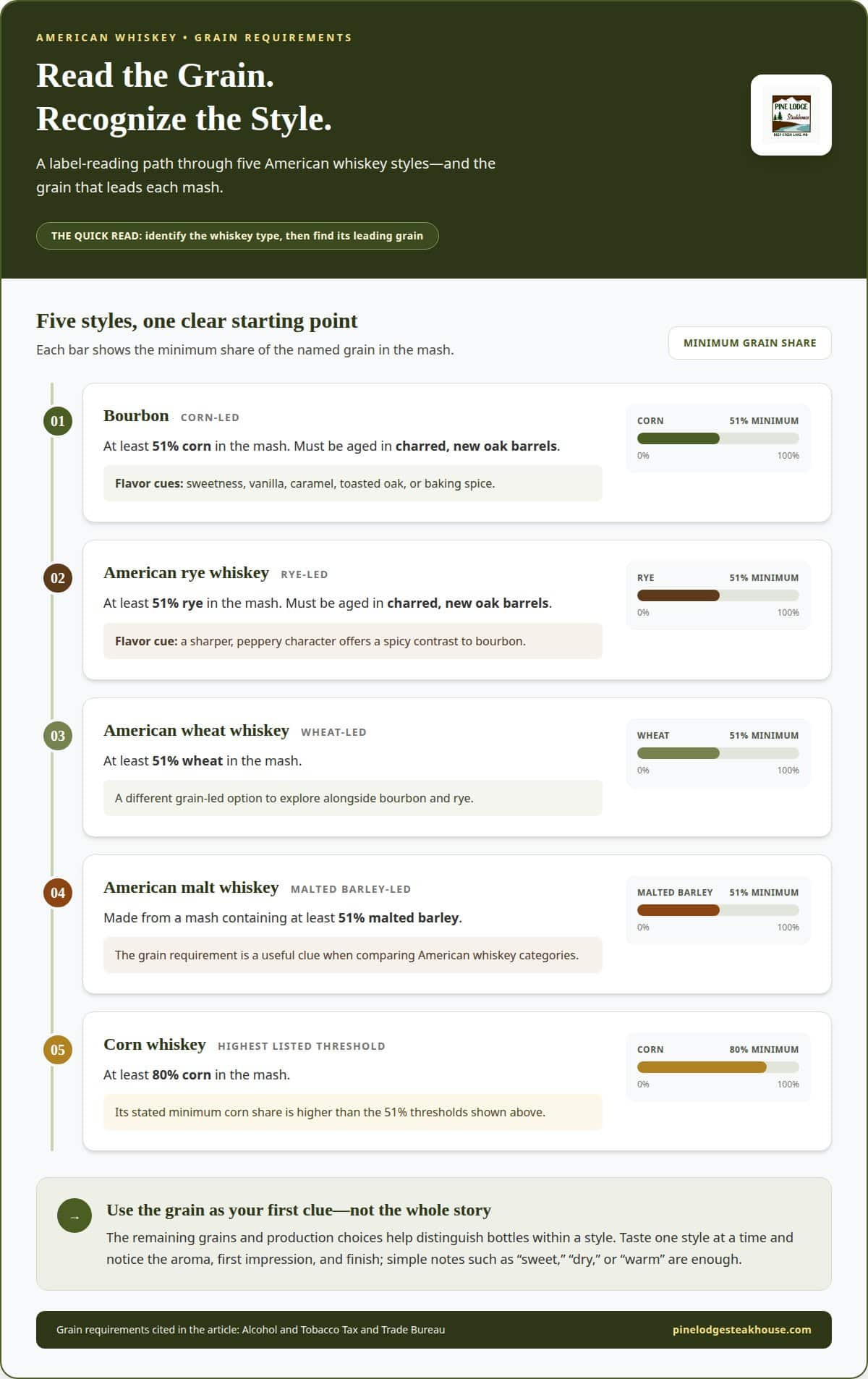
The grain rules offer useful context for those impressions. According to the Alcohol and Tobacco Tax and Trade Bureau, bourbon must contain at least 51 percent corn and be aged in charred, new oak barrels. American rye whiskey must contain at least 51 percent rye and be aged in charred, new oak barrels. American wheat whiskey must contain at least 51 percent wheat, according to the Alcohol and Tobacco Tax and Trade Bureau. The remaining grains and production choices help distinguish individual bottles within each style.
Use the differences as a tasting path. Start with bourbon if you enjoy a rounded, sweet impression; try rye for a sharper, peppery character. Wheat whiskey offers another grain-led option. Taste one style at a time, noting the aroma, first impression, and finish. A note such as “vanilla” or “pepper” is a helpful memory aid, not a required answer. If a flavor is hard to name, describing it as sweet, dry, or warm is enough to guide your next choice.
Bourbon and rye regulations also help decode the label. Their required grain percentages distinguish the styles, and both must use charred, new oak. A bourbon label signals a corn-led mash, while rye whiskey requires rye to meet its minimum share. For beginners, these label clues are a practical starting point before considering tasting notes or brand reputation. They help you compare categories without expecting every bottle in one style to taste alike.
For a first selection, choose a bourbon profile that sounds appealing, then taste it before trying it in a mixed drink. If its sweetness feels too rich, rye can offer a spicier contrast; wheat whiskey gives you a different grain to explore. A specialty bourbon selection can make the comparison part of a meal, alongside Hand-Cut Steaks or another dish with savory depth. Reserve a table for a relaxed dinner and an opportunity to explore bourbon with food.
3. American whiskey styles and grain requirements
Grain requirements give American whiskey labels their clearest distinctions. According to the Alcohol and Tobacco Tax and Trade Bureau, bourbon must contain at least 51 percent corn and be aged in charred, new oak barrels. American rye whiskey must contain at least 51 percent rye and be aged in charred, new oak barrels, according to the same agency. Those thresholds identify each style, while the rest of the mash bill can vary.
Other categories put different grains in the foreground. American malt whiskey must be made from a mash containing at least 51% malted barley, according to the Alcohol and Tobacco Tax and Trade Bureau. Corn whiskey must contain at least 80% corn in its mash, according to the same agency. These figures offer a practical label-reading shortcut: note the whiskey type, then identify the grain that leads its mash. The grain is only one part of the flavor, but it gives you a useful starting point for comparing styles.
American blended whiskey offers another approach. Its label does not use a specific grain-bill designation unless the whiskey contains at least 51% of a single grain. That distinction helps separate a named grain style from a blend whose character may draw on more than one whiskey. “Single malt” also points to malted barley as the grain of interest, though the phrase alone doesn’t tell you everything about the whiskey’s flavor or production. Check the style name alongside the distillery and tasting notes for a fuller picture.
Compare bottles in three steps: identify the named style, look for its required grain, and note any age or flavor details shown. A bourbon label indicates a corn-led whiskey, while an American rye label signals a rye-led one. A malt whiskey points to barley, and corn whiskey makes corn especially prominent. This method works across bottles from different parts of the country without assuming that every whiskey in one category tastes identical.
Store American whiskey upright, tightly sealed, and away from direct sunlight and strong temperature swings; it doesn’t continue aging in the bottle. After opening, air can gradually alter its aroma and flavor, so it generally won’t improve simply by sitting open. A secure cap helps preserve the profile you chose, whether it’s a corn-forward bourbon, rye whiskey, or barley-led malt.
Think of grain rules as a map, not a flavor guarantee. Two bourbons can both meet the corn requirement yet offer different aromas because their recipes and production choices differ. The same is true of rye and malt whiskey. For beginners, noting the grain, style, and distillery makes it easier to remember what stood out and choose a different profile next time.
4. Choosing whiskey for cooking and cocktails
Choose whiskey based on how you’ll use it. In a cocktail, it should remain noticeable alongside citrus, sugar, bitters, or vermouth. In a sauce or glaze, its aroma should complement the other ingredients without taking over. A mid-quality bottle is a practical choice for cocktails, where several flavors share the glass. Save a distinctive bottle for sipping if its character deserves the spotlight.
For an Old Fashioned, bourbon’s rounded sweetness works with bitters and a little sugar. Rye gives the drink a drier, spicier direction. A Manhattan pairs whiskey with sweet vermouth and bitters, so rye’s sharper profile can balance the herbal sweetness. These are starting points, not strict rules. Try the same recipe with bourbon and rye, then notice which spirit stays present through the finish.
Match whiskey to a dish’s dominant flavors. Bourbon can complement brown sugar, roasted fruit, or a barbecue glaze, while rye can add peppery notes to savory sauces. Add a modest splash while simmering, then taste before adding more. As the sauce cooks, liquid reduces and flavor concentrates. A whiskey that tastes forceful straight may become even more pronounced in a reduced glaze.
In a pan sauce, whiskey can lift browned bits left after searing meat. Take the pan off the heat before adding it, then return it to gentle heat and stir. This helps loosen the browned fond and blend the spirit into the sauce. Avoid pouring whiskey near an open flame. For dessert, bourbon can complement caramel or baked apples, while smoky Scotch whisky may overwhelm delicate cream or fruit.
For cocktails, Knob Creek 9 Year Single Barrel Reserve is one example recommended for both sipping and mixing. Its role depends on the recipe: a spirit-forward drink gives the whiskey more room, while citrus or sweet mixers can soften its edge. Start with a classic recipe, measure ingredients consistently, and change one element at a time. That makes it easier to identify whether the whiskey or the mixer shaped the result.
Keep a simple tasting note for each bottle you use in the kitchen or bar. Record the style, recipe, and whether the result seemed sweet, spicy, smoky, or oak-forward. If a sauce tastes too sweet, try rye next time; if a cocktail feels too sharp, bourbon may round it out. These comparisons help you choose whiskey with purpose instead of reaching for the same bottle in every dish or drink.
Bourbon vs Rye: Flavor, Ingredients, and Cocktails
The grain bill is the clearest starting point for comparing bourbon and rye. Bourbon must contain at least 51 percent corn and age in charred, new oak barrels; the Alcohol and Tobacco Tax and Trade Bureau sets this standard. American rye whiskey must contain at least 51 percent rye and age in charred, new oak barrels, according to the same agency. The shared barrel rule doesn’t make them taste alike: their leading grains create different foundations.
Corn often gives bourbon a fuller, sweeter impression, with notes that may suggest vanilla, caramel, or toasted grain. Rye commonly leans drier and spicier, with pepper, herbs, or a brisk finish. These are useful profiles, not guarantees for every bottle. A bourbon’s other grains and production choices matter, as do the recipe and aging of a particular rye. Compare the aroma and finish as well as the first sip.
These contrasts explain why the styles work differently in familiar cocktails. An Old Fashioned, built around whiskey, sugar, and bitters, gives either spirit room to show its character. Bourbon tends to make the drink rounder, while rye adds a sharper edge. In a Manhattan, rye’s spice can balance sweet vermouth; bourbon makes a softer, sweeter variation. A Whiskey Sour’s lemon and sugar add brightness, and bourbon’s rounded profile often suits the combination.
Rye also has a classic place in the Sazerac, where its spice stands up to bitters and the drink’s aromatic finish. That doesn’t mean bourbon is out of place. Choosing between them comes down to balance: consider whether the recipe needs sweetness, spice, or a more assertive whiskey note. To compare them, taste both neat, then try each in the same cocktail recipe. Changing only the whiskey makes the contrast easier to notice.
At the table, bourbon’s warmth can complement savory flavors, while rye can provide a lively counterpoint to rich or sweet ingredients. For example, compare a bourbon cocktail with a rye Manhattan alongside a meal, paying attention to whether the drink echoes or cuts through the food. A specialty bourbon selection or specialty cocktail can make that exploration part of an evening out. Reserve a table to explore bourbon and rye with dinner.
Pine Lodge Steakhouse
Pine Lodge Steakhouse is a natural place to explore American whiskey over a meal in McHenry, near Deep Creek Lake. Its Specialty Bourbon Selection lets you enjoy bourbon in a relaxed dining setting, alongside Hand-Cut Steaks, Slow Roasted Prime Rib, or Creamy Crab Soup. Comparing a whiskey with different dishes can bring its grain and flavor distinctions into focus. Turn label knowledge into an enjoyable meal, whether you’re new to bourbon or already know the profiles you prefer.
For a welcoming evening of food and whiskey, contact Pine Lodge Steakhouse.
Make Your Next Pour Part of the Experience
Let your next whiskey choice reflect the occasion, not just the label. Tasting at home can help you settle on a favorite; a meal offers another way to notice how a pour pairs with savory, rich, or creamy flavors. Keep your own preferences at the center. The most useful guide to American whiskey for beginners is one that helps you choose with confidence and enjoy each glass at your own pace.
At Pine Lodge Steakhouse in McHenry, near Deep Creek Lake and Wisp Resort, enjoy a Specialty Bourbon Selection with Hand-Cut Steaks, Slow Roasted Prime Rib, or Creamy Crab Soup. Think about what you’d like alongside your pour, then let the meal shape the occasion. Whether you’re planning a relaxed dinner or marking a special evening, a welcoming table gives you room to savor the pairing and discover what you enjoy.
Contact Pine Lodge Steakhouse to plan your next visit, and enjoy exploring whiskey one thoughtful pour at a time.
Frequently Asked Questions
What is whisky?
Whisky is a distilled alcoholic drink made from fermented grain mash, such as corn, rye, barley, or wheat. Fermentation creates alcohol, distillation concentrates it, and aging in wooden casks can add color and flavors such as spice or oak. “Whiskey” and “whisky” are spelling variations used in different traditions. American whiskey usually names its style by grain, production method, or place, helping distinguish it from Scotch or Irish whiskey.
What are the main types of American whiskey, including bourbon, rye, Tennessee whiskey, and American single malt?
The main styles include bourbon, rye, Tennessee whiskey, and American single malt. Bourbon is corn-led, rye is rye-led, and American malt whiskey emphasizes malted barley. Tennessee whiskey is identified with Tennessee, while American single malt describes a malt-focused American style. The category name is a starting point, not a complete flavor prediction: the other grains, distillery choices, and aging can shape each bottle’s character.
What are the legal requirements for bourbon, rye whiskey, and Tennessee whiskey in the United States?
American rye whiskey must contain at least 51 percent rye and be aged in charred, new oak barrels, according to the same agency. Tennessee House Bill 1084 passed in 2013. That date alone does not describe every requirement for Tennessee whiskey, so don’t infer a specific production process from it.
What do whiskey labels mean, including straight, bottled-in-bond, proof, age statements, and mash bill?
“Straight” and “bottled-in-bond” describe production standards, while “proof” indicates alcohol strength. An age statement tells you the stated aging period, and the mash bill is the grain recipe. For bottled-in-bond whiskey, the Alcohol and Tobacco Tax and Trade Bureau requires bottling at 50 percent ABV. Read these details together: the mash bill signals grain emphasis, while strength and age provide separate clues about the bottle.
Good beginner choices depend on the flavor you want, not a price tier alone. For a first comparison, try a corn-forward bourbon, then a rye to explore a spicier profile. Wild Turkey 101, I.W. Harper 15 Year, Blade & Bow 22-year bourbon, and Knob Creek 9 Year Single Barrel Reserve are examples discussed in this guide. Bottle prices vary, so use your budget as a limit and compare labels and styles within it.
Which American whiskey brands and bottles are widely available in the United States?
Examples of American bottles to recognize include Wild Turkey 101, I.W. Harper 15 Year, Blade & Bow 22-year bourbon, and Knob Creek 9 Year Single Barrel Reserve. They provide different starting points for comparing strength, age statements, and style. Availability varies by retailer and location, so treat these as names to recognize rather than a guarantee of what every shelf carries. A local selection may offer other expressions worth exploring.
How should beginners taste whiskey, and what glass, serving temperature, or water should they use?
Start with a small pour in a glass that narrows near the rim to help concentrate aromas. Smell gently, take a sip, and notice the first taste and finish. Try it at room temperature before changing anything; then add a little water if the alcohol feels sharp. Some drinkers use one or two drops, while a small splash can reveal different notes. No single temperature or glass suits every whiskey.
What is the difference between drinking whiskey neat, with water, on the rocks, and in cocktails?
Neat means whiskey served by itself, without added water or ice. A few drops or a splash of water can soften the alcohol impression and bring out other aromas. On the rocks means serving it over ice; as the ice melts, it dilutes the whiskey and can mute some flavors. Cocktails combine whiskey with ingredients such as bitters, citrus, or vermouth, creating a different balance in each drink.