
What if bourbon tasting notes aren’t answers you have to get right, but clues that help you enjoy what’s in your glass? If words like caramel, oak, or spice don’t match what you notice, you’re not tasting incorrectly. Understanding bourbon tasting notes starts with trusting your own senses, not memorizing someone else’s vocabulary or treating a pour like a test.
With a little attention, you can recognize familiar aromas and flavors, describe them in plain language, and feel more at ease exploring a new bourbon. This beginner’s guide explains how to approach the aroma, take a thoughtful sip, and use tasting descriptions as prompts rather than rules. You’ll also find simple ways to notice how food affects your impressions. At Pine Lodge Steakhouse in McHenry, a specialty bourbon selection can accompany a relaxed meal of hand-cut steak or slow-roasted prime rib. Whether you’re visiting Deep Creek Lake or enjoying the local area, no expert palate is required. Start with curiosity, notice what stands out, and let your own impressions lead.
Key Takeaways
- Tasting notes are sensory impressions, not proof of added ingredients or a test with right answers.
- Use a simple sequence to give aroma, flavor, texture, and finish each a moment of attention.
- Compare common flavor families as helpful prompts, while allowing several notes to overlap in one pour.
- Build confidence in understanding bourbon tasting notes by recording your first impressions before reading others’ descriptions.
- Bring your observations to a relaxed meal at Pine Lodge Steakhouse, where a specialty bourbon selection pairs naturally with a steakhouse dinner.
What Do Bourbon Tasting Notes Mean?
Bourbon tasting notes are words for what you notice when you smell and taste a pour: its aromas, flavors, texture, and lingering sensations. You might sense sweetness in the aroma, warmth across your tongue, or a dry finish. These descriptions help put an experience into words, but they’re impressions, not a checklist every drinker must complete.
A tasting note is not a flavor ingredient. “Vanilla” describes an aroma or flavor you perceive, not a promise that vanilla was added. A bourbon’s character develops through its ingredients and production, while personal senses shape how each person describes it. For foundational background, Bourbon whiskey offers an overview of the spirit’s definition and history.
As you begin understanding bourbon tasting notes, sort your impressions into broad families. These categories are starting points, not rules:
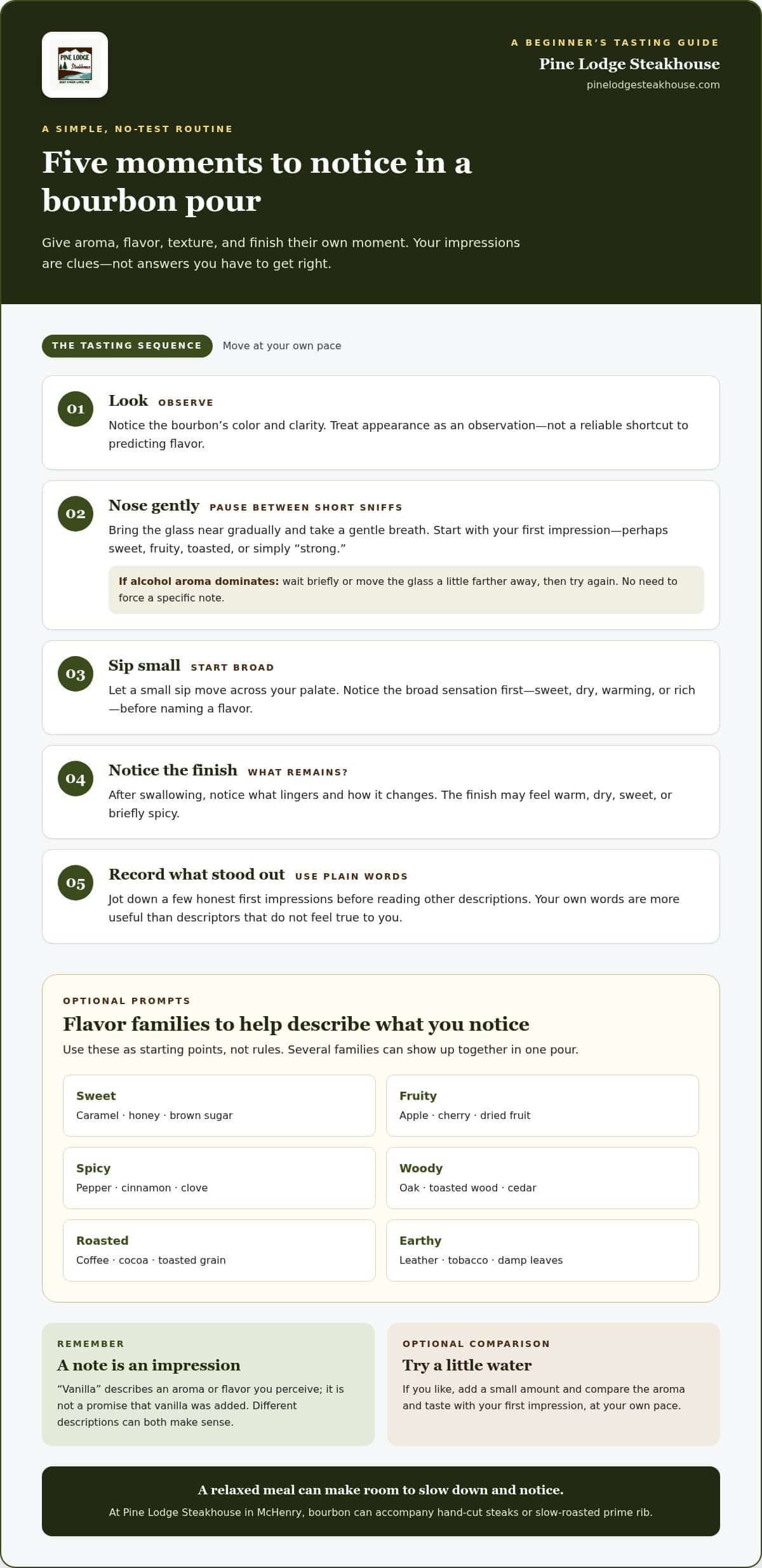
- Sweet: caramel, honey, or brown sugar
- Fruity: apple, cherry, or dried fruit
- Spicy: pepper, cinnamon, or clove
- Woody: oak, toasted wood, or cedar
- Roasted: coffee, cocoa, or toasted grain
- Earthy: leather, tobacco, or damp leaves
Several families may show up together. Your own plain-language description is just as useful as a familiar tasting term.
Why Bourbon Can Suggest Caramel, Vanilla, Oak, or Spice
Flavor begins before the pour reaches your glass. The grain mixture, fermentation, and distillation all help shape a bourbon’s character, while time in a charred oak barrel can contribute aromas and flavors. American white oak may lend wood-derived notes such as vanilla, toasted wood, or spice, though the result varies from one bourbon to another.
Caramel, vanilla, and spice are common examples, not a mandatory checklist. One pour might suggest baking spice and oak; another may seem sweeter or fruitier. You don’t need to find every note to understand what you’re tasting.
Are Bourbon Tasting Notes Objective or Personal?
Some aspects of a pour, such as its aroma or warming sensation, can be noticed directly. The words you choose are more personal. Experience and memory influence associations, while temperature and attention can change what stands out. A scent that reminds one person of baked fruit might bring another person to think of jam.
Different descriptions can both make sense for the same bourbon. Start with familiar words: sweet, smoky, sharp, smooth, or dry. Specialist terms can come later. The goal isn’t to prove your palate is right; it’s to notice more and describe the experience honestly.
How to Taste Bourbon and Notice Its Aromas and Flavors
A simple routine gives each part of a pour room to register. You don’t need specialist glassware or a formal tasting room. Choose a calm spot, place the glass where you can see it, and take your time. A curved glass can gather aromas near the rim, while a quieter setting makes them easier to notice. An ordinary glass and a few unhurried minutes work too.
Look, nose gently, sip small, notice the finish, then record what stood out. That’s a practical sequence for understanding bourbon tasting notes without turning the experience into a test.
- Look: Notice the bourbon’s color and clarity. Treat appearance as an observation, not a reliable shortcut to predicting flavor.
- Nose: Bring the glass toward your face gradually and take a gentle breath. Pause, then try again. Notice your first impression before searching for a specific aroma.
- Sip: Take a small sip and let it move across your palate. Start with the broad sensation, such as sweet, dry, warming, or rich, before naming a flavor.
- Notice the finish: After swallowing, pay attention to what remains and how it changes. The finish may feel warm, dry, sweet, or briefly spicy.
- Record: Jot down a few plain words. An honest first impression is more useful than a string of descriptors that don’t feel true to you.
How to Nose Bourbon Without Overwhelming Your Senses
Hold the glass comfortably and bring it near rather than taking a sharp, deep inhale over the rim. Pause between short sniffs and put the first impression into everyday language: sweet, fruity, toasted, or simply “strong.” If alcohol aroma dominates, wait briefly or move the glass a little farther away before trying again. There’s no need to force a more specific answer.
How to Notice Flavor, Texture, and Finish
Give each stage its own moment: the first taste, the flavor as it develops, the mouthfeel, and the lingering finish. Notice whether the bourbon feels light or weighty, smooth or drying, and how much warmth it leaves. If you’d like, add a small amount of water and compare the aroma and taste with your first impression. Make the comparison at your own pace.
A relaxed meal can offer a welcoming setting to slow down and pay attention to a pour. At Pine Lodge Steakhouse in McHenry, enjoy bourbon alongside hand-cut steaks or slow-roasted prime rib, whether you’re dining near Deep Creek Lake or visiting Wisp Resort. Plan a meal at Pine Lodge Steakhouse and let the tasting unfold naturally, one sip at a time.
How to Interpret Common Bourbon Tasting Notes
Flavor descriptions can work like a map, not a verdict. As you taste, separate what you smell before sipping from what you notice as you sip. Aroma is perceived through the nose, while flavor develops as you sip and includes both taste and aroma. One pour may suggest several things at once, such as a sweet aroma followed by toasted flavors and a drying finish. You don’t have to choose one definitive note.
Use the table as a set of prompts. These are illustrative possibilities, not required characteristics or literal ingredients.
| Sensory family | Possible descriptors | Try noticing |
|---|---|---|
| Sweet | Caramel, vanilla, honey | Does the aroma or sip feel gently sweet, rich, or confection-like? |
| Fruity | Dried fruit, apple, cherry | Does anything bring to mind fresh fruit, jam, or fruit that’s been dried? |
| Roasted | Toasted grain, cocoa, coffee | Is there a warm, browned or toasted impression? |
| Woody | Oak, toasted wood | Do you notice a dry, woody quality in the aroma or finish? |
| Spicy | Baking spice, pepper | Is the impression aromatic, sharp, or tingling? |
Sweet, Fruity, and Roasted Notes
To explore sweetness, compare what you smell or taste with familiar aromas: caramel from a browned dessert, vanilla, or dried fruit. That’s a comparison, not a claim that those ingredients were added. A roasted impression might bring toasted grain or cocoa to mind. If you’re unsure, “sweet and toasted” is clearer and more useful than listing flavors you’re only guessing at.
Oak, Spice, and Other Sensations
Oak might describe a wood-like aroma or flavor; baking spice and pepper can describe aromatic or sharper impressions. Keep those apart from physical sensations. Warmth is the feeling of alcohol’s heat, while dryness describes a drying sensation that may linger after a sip. A pour can show one, several, or none of these impressions, depending on both the bourbon and the person tasting it.
Tasting notes vary because each person brings different memories, senses, and expectations to the same glass. That doesn’t make one description automatically right and another wrong. If someone says “vanilla” and you notice “sweet oak,” both may be honest ways to describe overlapping impressions. Understanding bourbon tasting notes means using descriptors to communicate what you notice, not matching another person’s words. Begin with the clearest impression, then add detail only when it feels genuine.
How to Write Bourbon Tasting Notes Without Guessing
Your notes don’t need to sound like a tasting-room expert’s. They just need to help you remember what you experienced. Write your first impressions before reading a label or someone else’s description. That way, your observations lead, and other tasting notes can offer ideas afterward rather than dictate what you’re supposed to find.
A useful note can be as simple as “sweet aroma, warming sip, dry finish.” To make it more precise, add a descriptor you feel confident about: “sweet, like dried fruit, with a warming sip and dry finish.” Leave out anything that feels like a guess. In understanding bourbon tasting notes, a few honest words are more valuable than an impressive-sounding list.
A Simple Bourbon Tasting Notes Template
Use these prompts to keep your notes clear and brief. A word or short phrase is enough, and a blank is fine if nothing distinct comes to mind.
- Appearance: What do you notice about the color or clarity?
- Aroma: What’s your first impression before sipping?
- Palate: What stands out in the first sip and as it develops?
- Texture: Does it feel light, rich, warming, smooth, or drying?
- Finish: What sensation or flavor lingers?
- Overall impression: Did you enjoy it? Would you choose it again?
Keep the record for your own reference, not as a scorecard. If you’re curious, compare two pours using the same prompts and note where they differ. You don’t need to compare every bourbon you try.
Your preferences are useful information. If you enjoy a sweeter impression or prefer less heat, that helps you understand what you like; it doesn’t mean you’ve tasted incorrectly. A tasting note describes your experience, not your skill.
How Food Can Change What You Notice
A sip alongside food may seem different from one tasted on its own. Sweet, salty, rich, or smoky flavors can shift how the bourbon’s balance comes across. Try a small taste before a bite, then another after. A hand-cut steak or a piece of dark chocolate can be an optional point of comparison, not a pairing rule. Notice whether the bourbon seems sweeter, drier, or less prominent with food, and jot down the change.
At Pine Lodge Steakhouse, slow-roasted prime rib and a specialty bourbon selection make a relaxed combination for exploring your impressions. Reserve a table at Pine Lodge Steakhouse and enjoy bourbon as part of your meal.
Explore Bourbon Tasting Notes at Pine Lodge Steakhouse
Bourbon appreciation doesn’t need a formal tasting room or a practiced vocabulary. It can be as simple as slowing down over dinner, noticing what you enjoy in the glass, and seeing how a meal changes your impressions. Pine Lodge Steakhouse in McHenry offers a specialty bourbon selection in a lodge-style steakhouse setting, making it easy to bring your curiosity to the table. It’s a natural stop for a meal while exploring Deep Creek Lake or Wisp Resort.
Enjoying Bourbon Alongside a Steakhouse Meal
Try a sip before your meal, then revisit the bourbon after a bite. Does its sweetness seem more pronounced, does spice stand out, or does the finish feel different? Food can shift your perception, so describe what changes rather than expecting a particular pairing to work for everyone. A hand-cut steak or slow-roasted prime rib offers a hearty meal to enjoy alongside a pour, but your own response is what matters.
If you’re planning dinner in the Deep Creek Lake area, Pine Lodge’s specialty bourbon bar guide and Deep Creek Lake dining guide can offer more local context. Keep the tasting casual: notice what appeals, and let your notes be as simple as “sweet before dinner, warmer afterward.”
Turn Tasting Curiosity Into a Welcoming Dinner
A specialty bourbon selection gives you a chance to explore different impressions as part of a relaxed meal, without needing to arrive with a list of expected flavors. Start with what you notice and what you like. If a sip brings to mind sweetness, spice, or lingering warmth, those are useful observations, whether or not they match another person’s description.
That’s the heart of understanding bourbon tasting notes: curiosity matters more than getting every descriptor right. Enjoy your pour at an unhurried pace, alongside the dishes that make dinner satisfying. For visitors exploring McHenry, Deep Creek Lake, and Wisp Resort, Pine Lodge Steakhouse offers a place to enjoy bourbon with a steakhouse meal.
Reserve a table at Pine Lodge Steakhouse and enjoy a relaxed dinner with a specialty bourbon selection.
Bring a Little More Curiosity to Your Next Pour
Understanding bourbon tasting notes is less about finding the “right” flavor and more about paying attention to your own experience. Notice the aroma before sipping, then consider flavor, texture, and finish. Use familiar words first, and treat common descriptors as prompts, not a checklist. Different impressions can coexist, and your personal preferences are part of what make tasting worthwhile.
Try the same unhurried approach at dinner. A bite of food may shift how a bourbon’s sweetness, spice, or finish comes across, giving you something new to notice without turning the meal into a test.
In McHenry, Pine Lodge Steakhouse is a locally owned restaurant serving a specialty bourbon selection alongside a steakhouse meal. Whether you’re visiting Deep Creek Lake or Wisp Resort, bring your curiosity, trust what you notice, and enjoy each sip at your own pace.
Reserve a table and explore Pine Lodge’s specialty bourbon selection. Your next pour doesn’t need perfect tasting notes, just an open mind and a moment to savor it.
Frequently Asked Questions
What are bourbon tasting notes?
Bourbon tasting notes are words that describe aromas, flavors, textures, and sensations you notice while smelling and sipping bourbon. Descriptors such as caramel, oak, or pepper communicate an impression, not a promise that those ingredients were added. Understanding bourbon tasting notes means using the words as helpful prompts, then choosing descriptions that honestly match your own experience.
How do you taste bourbon for beginners?
Start by looking at the pour, then bring the glass close and smell gently. Take a small sip and notice its first impression, how the flavor develops, the texture, and what lingers in the finish. Use simple words such as sweet, warming, or dry before trying more specific descriptors. A quiet setting can help you focus, but you don’t need special equipment.
Is bourbon supposed to taste like vanilla or caramel?
No single flavor is required in your experience of a bourbon. Vanilla and caramel are common descriptors, but they’re sensory impressions, not a checklist or proof of added flavoring. Depending on the pour and your palate, you might notice oak, fruit, spice, toasted grain, or something else entirely. If you don’t find vanilla or caramel, you’re not tasting incorrectly.
Can two people taste different notes in the same bourbon?
Yes. Two people can describe the same bourbon differently because senses, memories, expectations, and attention vary. One person might call an impression dried fruit while another notices sweetness or spice. Both descriptions can be reasonable. Tasting notes aren’t a test with one correct answer, so start with the words that feel clear to you instead of trying to match someone else’s description.
What is the difference between bourbon aroma and flavor?
Aroma is what you notice by smelling the bourbon before you sip. Flavor is the experience as you taste it, shaped by what you sense on your tongue and the aromas you perceive while sipping. You may smell a sweet impression, then find the sip more peppery or dry. Noting aroma and flavor separately can help you describe how the pour changes from nose to palate.
Does adding water change bourbon tasting notes?
It can change what you perceive. A small addition of water may shift the bourbon’s aroma, flavor, or overall balance, though the effect varies by pour and person. To explore the difference, smell and taste first, then add a little water and compare. Notice whether anything becomes more apparent or seems softer. There’s no need to add water if you prefer the original pour.
How do you write a bourbon tasting note?
Write a few first impressions before reading another person’s description. Note the aroma, first sip, texture, finish, and whether you enjoyed the pour. Keep it plain: “sweet aroma, warming sip, dry finish” is a useful note. Add a specific descriptor only when it feels genuine, and leave a prompt blank if nothing stands out. At Pine Lodge Steakhouse in McHenry, you can explore your impressions with a specialty bourbon selection during a meal near Deep Creek Lake and Wisp Resort.